From Nightclub Corners to Dedicated Stages
Long before the stand-up was classified as a genre, these jesters of the working class worked in many arenas outside the comedy club - hotel ballrooms, supper clubs, Catskills resorts, and Village coffeehouses, where both the comic and the folk singer could be part of the bill with some poet. The comic was never the main attraction. From the late 1950s to early 1960s, stand-up performed as the second doggy, the sorbet to go between the courses.
The Shift from Variety Entertainment to Stand-Up as a Distinct Live Art
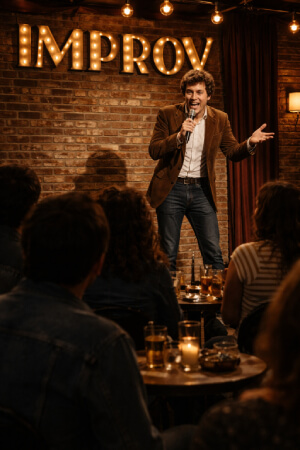
That changed in 1963 when Budd Friedman opened The Improv on West 44th Street in New York City, initially as a rehearsal space for Broadway performers. Comedians began filtering in, and Friedman recognized what he had. By the late 1960s, The Improv had effectively become the first venue in the country dedicated to stand-up as a headline form. Catch a Rising Star followed in 1972, just blocks away, drawing performers like Andy Kaufman and Richard Lewis. On the West Coast, Mitzi Shore opened The Comedy Store on Sunset Strip in 1972, and Los Angeles suddenly had its own proving ground.
Urban density made this model viable in ways that touring or television couldn't replicate. A 150-seat room in Manhattan or West Hollywood needed only modest ticket revenue to cover costs. Performers could work multiple clubs in a single night, testing material in front of real audiences and refining it fast.
Why the Club Format Suited Confessional, Observational Comedy
There's no denying the intimacy of a small club shaped what stand-up became. Seated close together in low-lit rooms, audiences responded differently than they did in theaters or on television. The confessional, observational style that defined comedians like Joan Rivers, Robert Klein, and later Jerry Seinfeld depended on proximity. A joke about a bad date or a difficult parent landed harder in a 200-seat club than on a stage built for spectacle.
The physical format essentially demanded personal material. Broad, vaudevillian comedy felt wrong in a room that small. What worked was specific, honest, and slightly uncomfortable — which is exactly what modern stand-up became.
The Role of Club Owners in Shaping Early Lineups
Behind the scenes, club owners and bookers played a quiet but decisive role in defining what stand-up would become. Figures like Budd Friedman and Mitzi Shore were not just venue operators; they acted as curators, deciding which voices made it to the stage and which styles resonated with audiences. Their choices influenced not only individual careers but also the broader direction of comedy as a live art form.
These gatekeepers often took risks on unconventional performers who didn’t fit traditional entertainment molds. By giving stage time to comics experimenting with new tones, pacing, or subject matter, they helped expand what audiences expected from stand-up. Over time, this created a feedback loop: clubs shaped comedians, and comedians, in turn, reshaped the identity of the clubs themselves.
The Comedy Boom and the Club as Career Engine
Great changes took place in America with the onset of the year 1975. Humble, local together almost to the neighbors had been dissolved into semi-professional regime. In these well-populated environments comedy competitions began to take place, with the cadre of deserving young comics parking their cars in front of these casual joints with a precise goal in mind: stage time had become a staple for their art as much as food and water were staple food for their bodies.
Repetition as the Real Curriculum
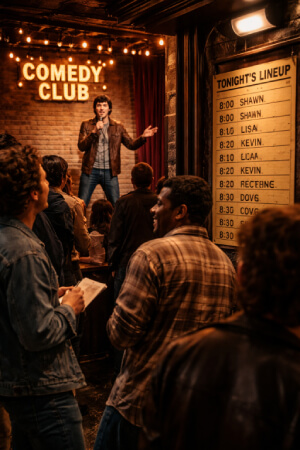
No comedy school existed. What clubs offered instead was the relentless grind of performing the same material to different crowds on consecutive nights until the timing clicked or the joke died permanently. Robin Williams, who became a fixture at San Francisco's Holy City Zoo in the mid-1970s, was known for performing multiple sets per night, testing ideas in real time. Jerry Seinfeld spent years working New York clubs including Catch a Rising Star and The Comic Strip, refining observational bits through sheer repetition long before NBC came calling. Joan Rivers built her voice at the same venues, absorbing audience feedback that no writing room could replicate. The club stage was unforgiving in exactly the way that mattered.
Talent Scouts and the Industry Pipeline
Booking agents, television producers, and late-night talent coordinators began treating clubs as reliable scouting grounds during the late 1970s. The Tonight Show's talent coordinators were reportedly regular presences at clubs like The Improv on West 44th Street, watching sets and flagging names worth a phone call. David Letterman's early club appearances helped establish the dry, cerebral persona that NBC eventually built a show around. Richard Pryor's club work, rawer and more politically charged than anything television would air, generated enough industry buzz to support a string of concert films and specials that redefined what stand-up could be commercially.
Cable television amplified the whole machine. HBO's Young Comedians specials, which began in 1977, gave club performers a national audience without requiring the sanitized format of network variety. Suddenly, what happened in a 200-seat room in Los Angeles could reach millions.
The Economics of Stage Time and Rapid Career Acceleration
As the number of clubs grew, so did the pace at which comedians could develop. Stage time was no longer scarce in major cities, and performers who were willing to hustle could appear in multiple venues in a single evening. This created an environment where progress was measurable. A joke that failed on Tuesday could be reworked by Wednesday and tested again by Thursday in front of a completely different crowd.
That density of opportunity accelerated careers in a way earlier generations never experienced. Comedians who adapted quickly could move from short opening spots to headlining sets within a few years, sometimes faster. At the same time, the system exposed weaknesses just as quickly. Without the ability to consistently deliver, performers struggled to secure bookings. The club circuit didn’t just reward talent. It rewarded discipline, resilience, and the ability to evolve under constant pressure.
Why Comedy Clubs Became Cultural Institutions
There's a reason audiences kept returning to cramped rooms with two-drink minimums and questionable sightlines. Something genuine happened inside comedy clubs that television, and later streaming, couldn't fully replicate: a live exchange between a performer and a room full of strangers, all negotiating the same anxieties at the same moment.
A Laboratory for Taboo, Dissent, and Social Commentary
From the beginning, the comedy club functioned as an informal public forum. During the 1960s and 1970s, venues like The Improv in New York and The Comedy Store in Los Angeles drew performers who were openly challenging the social consensus. Lenny Bruce had already established that stand-up could carry genuine political weight, and the clubs that followed created space for that tradition to grow. Richard Pryor used those stages not just to provoke laughter but to narrate Black American experience with an honesty that mainstream media wouldn't touch.
By the 1980s, the circuit had expanded dramatically, with hundreds of clubs operating across the country. The audiences were larger and more suburban, which meant the material was sometimes smoother and safer. Still, the club stage remained the place where comedians tested ideas before they were ready for television or specials. George Carlin refined his most incendiary material through years of live performance. The club was where the rough draft lived.
Artistic Risk Versus the Pressure to Sell Tickets
Commercialization always complicated that freedom. The comedy boom of the 1980s produced a glut of clubs chasing the same audience, and by the early 1990s the market had contracted sharply. Ticket prices rose, and bookers began favoring performers with television credits over unknowns willing to take risks. Some argue this squeezed out exactly the kind of experimental voices that had made clubs culturally relevant in the first place.
The digital era brought a different tension. Audiences accustomed to polished Netflix specials arrived expecting a finished product, not a work in progress. Yet that same period produced renewed appetite for live authenticity, with club attendance recovering steadily through the 2010s. The unscripted, unedited quality of a club set became its own selling point.
The Club Circuit Still Builds the Next Generation
Streaming specials and TikTok clips can make a comedian look established overnight, but there's no shortcut for what actually happens in a room of two hundred people on a Tuesday. The live club remains the only place where material gets genuinely tested, where a joke either lands or dies in real time, and where a performer learns to read an audience rather than perform for an algorithm.
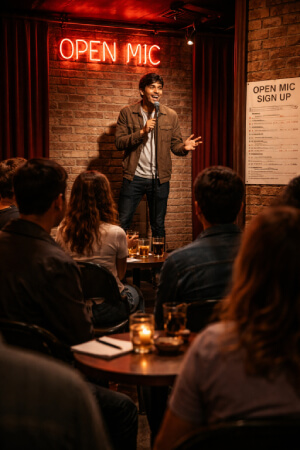
Open mics are still where most careers begin, often uncomfortably. A five-minute spot at a mid-tier club in Austin or Minneapolis might go badly, but that failure teaches more than a polished podcast appearance ever could. From open mics, comedians graduate to hosting spots and feature sets, building stamina and timing across dozens of rooms before a headline opportunity arrives. Regional touring extends that education further, exposing comics to audiences in smaller markets where nothing is guaranteed.
Established comedians return to clubs for the same reason. When Dave Chappelle road-tested material at small Ohio venues before his 2017 Netflix specials, he wasn't doing it for exposure. Working out new material away from cameras and critical attention is something the club room uniquely offers.
Diverse Scenes and Alternative Rooms Are Widening the Stage
The mainstream club circuit no longer holds a monopoly on who gets heard. Since the mid-2000s, alternative comedy rooms, queer showcases, and community-run nights in cities like Los Angeles, Chicago, and New York have created parallel pipelines for performers who didn't fit the traditional mold. Comedians like Tig Notaro and Hasan Minhaj built devoted followings through alternative and college circuits before major platforms came calling.
Legacy Clubs Hold Their Ground Even as Audiences Go Online
Venues like Carolines on Broadway, The Comedy Store, and The Punchline in San Francisco still carry institutional weight. Getting booked there signals something to the industry, regardless of how many Instagram followers a comedian has accumulated. Clubs remain the credentialing system that no streaming platform has managed to replace.
Comedy Clubs Still Shape Who Gets Heard
First noticed in New York in the 1980s, this style came as an unexpected response to the anemic Latin jazz of the period and its poor standing with contemporary audiences. The New York Latin-jazz fans wanted the music to adapt, to grow past its salad-days menu exceeding 90 minutes at the Vanguard, to supplant the set obligations at the Blue Note, to bring something more to the table than the nightly dat of a "true" madurez, an update of old songs, or new tunes hung on the scaffold of rhythm styles pursued in the 1970s, all blended with a backdrop of rum drinks and mojitos. In part this series is a tribute to the glorious giants like Tito Puente, who virtually invented reproduction, and trumpet legend Jerry González and his legion - masters always - including Chano Pozo, Mongo Santamaria, Willie Bobo, Kako El Masacre, Machito, Ray Barretto. These veterans. These master bandleaders. These eager board purveyors of the age-old musical art to generate connection.
With the kind help from